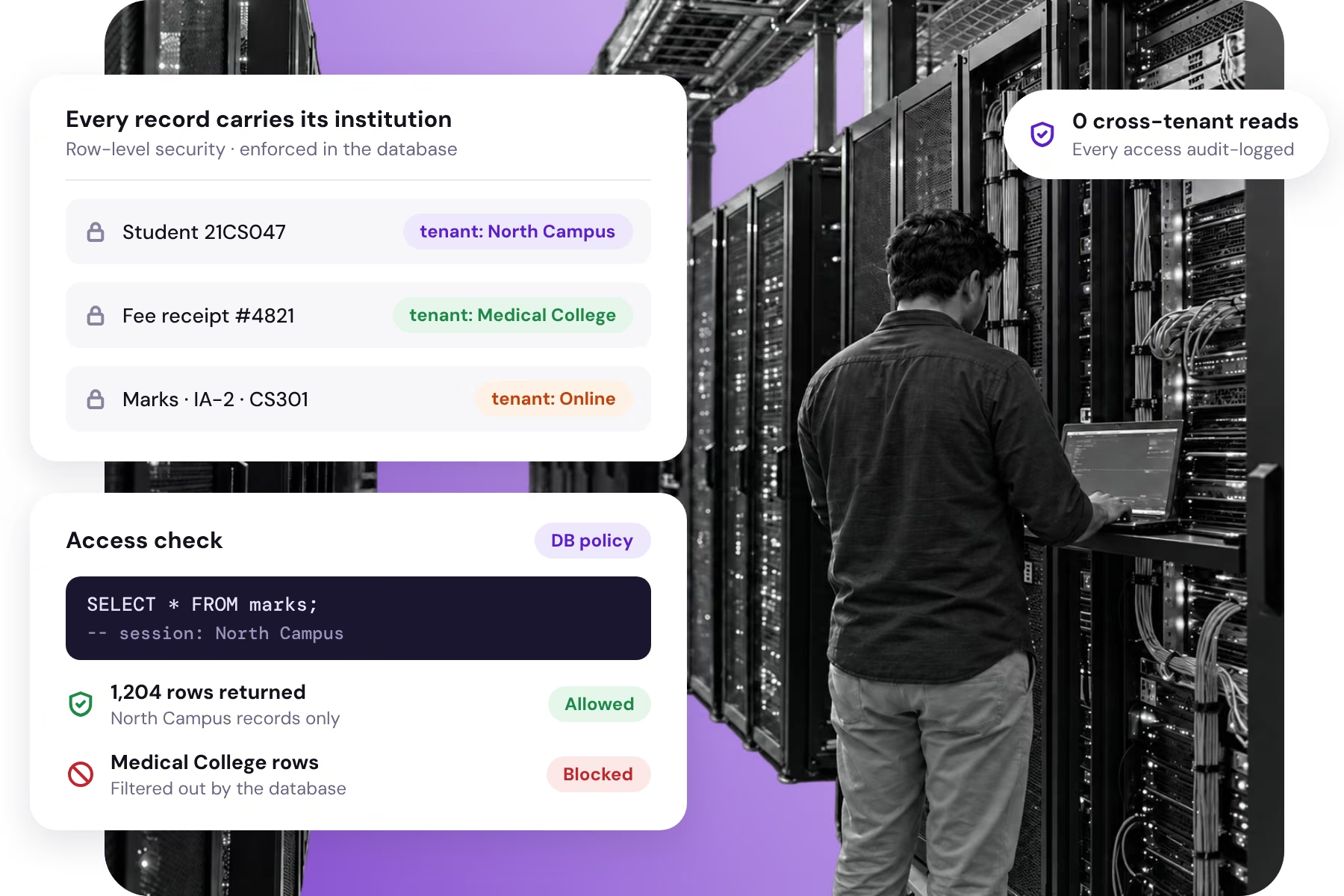
Enforced in the database, not the application
Every record carries its institution, and row-level security runs on every query. Even if an application asks the wrong question, the database refuses to return another institution’s data.

IT & Campus Infrastructure · IT Heads
In HexP, every record carries its institution, and access is enforced by the database itself. Isolation does not depend on application code getting every query right.

The problem
An IT head in higher education typically runs 15+ systems, each with its own login, integration, support contract, upgrade cycle and security posture.
The integration layer between them is often the most fragile — and least documented — part of the estate.
Consolidation is not just a cost argument. It is a risk argument.
Features
Every record carries its institution, and row-level security runs on every query. Even if an application asks the wrong question, the database refuses to return another institution’s data.
Institutional access comes from the signed-in user’s session, never from the request itself. AI services apply the same rule, preventing crafted requests from accessing another institution’s data.
Role-based access control sits on top of institutional isolation, with 37 defined roles and 24 purpose-built dashboards. Audit logs track user activity, with encryption in transit and at rest.
Where policy requires it, an institution can run on a completely separate database with the same product. No shared infrastructure. No compromise.
You are not being asked for a rip-and-replace.
OpenID configuration, JWKS endpoints and administrator-managed signing keys, so users keep one login.
Issued and revoked by you, tied to one institution, scope-controlled, rate-limited and immediately invalidated when revoked.
Students, users, fees, enrolments, courses and library records, with staged processing and reconciliation.
Payment gateways, biometric attendance, SCORM content and cloud storage, with defined integration paths.
Use only what you need. If your finance system works, keep it.

Each campus or digital entity is another instance with its own module set, not another deployment to maintain. Customisation that normally becomes a development request — fields, terminology, approval chains, notifications, roles and permissions — is configuration an administrator can manage. That work stops arriving in your queue.
A belief we are deliberately challenging
“A single unified university platform isn’t realistically possible.” Not when fifteen products are assembled behind one login — which is why the integration layer becomes the weak point. It is possible when the modules were designed as one platform from the start.
We would rather answer questions about isolation, identity, API governance and separation in detail than in a brochure.