One entry, everything downstream
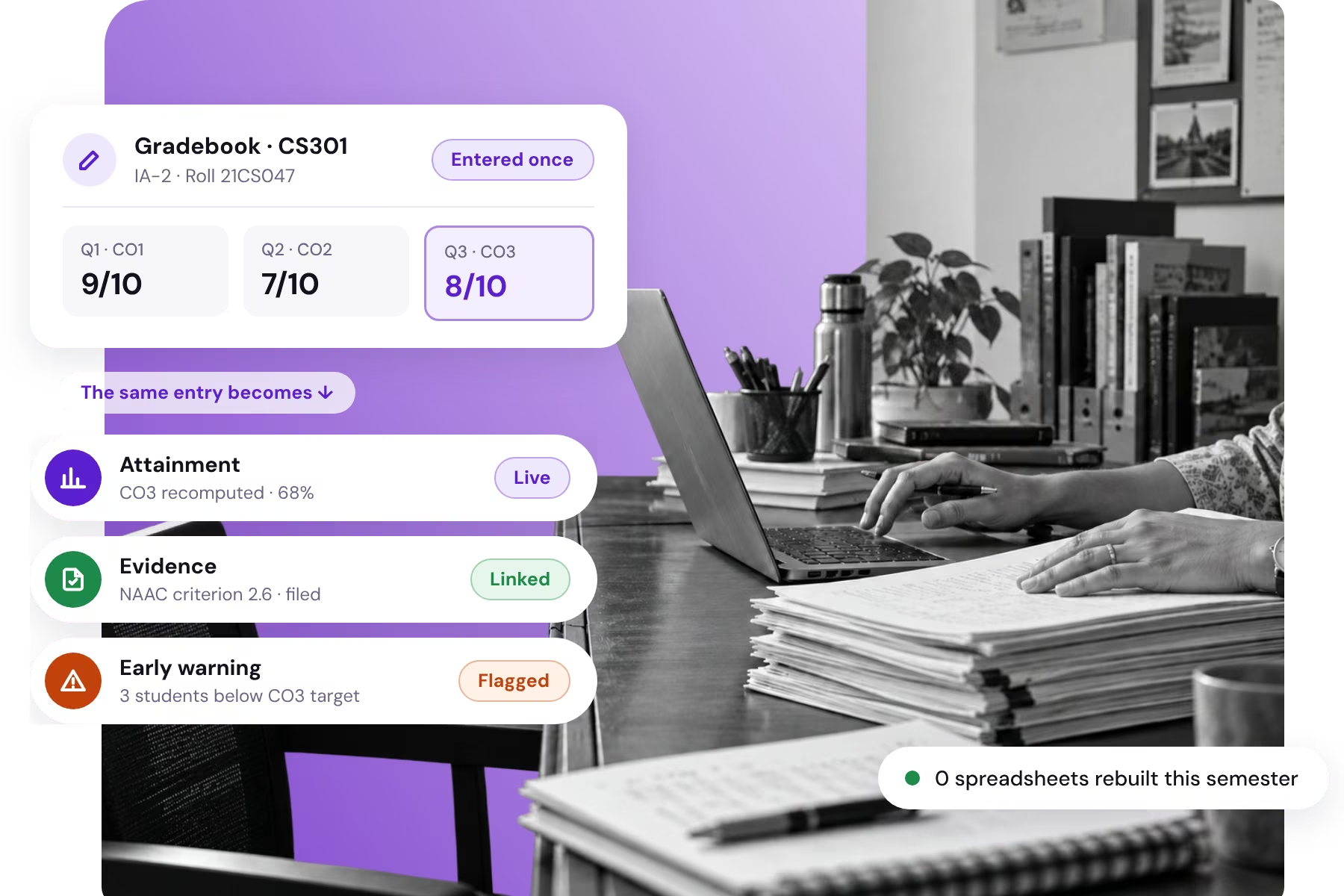
Enter the mark in the gradebook. Attainment is computed continuously throughout the semester. The evidence pack exports at audit time with nothing to prepare.

Academics & Faculty · Professors
Faculty across Indian higher education lose weeks each year rebuilding attainment spreadsheets from marks that were already recorded somewhere else. HexP computes attainment from the gradebook you already use — and turns the same entry into evidence, insight and early warning.

The problem
Outcomes are written once and filed. Marks go into a gradebook. Then, in the weeks before an audit, someone reconstructs attainment by hand — from data the institution already had, in a spreadsheet that will be rebuilt again next cycle.
It is not that the work is difficult. It is just clerical, repetitive, and has to be done by people who did not become teachers to do this work.
Features
Enter the mark in the gradebook. Attainment is computed continuously throughout the semester. The evidence pack exports at audit time with nothing to prepare.
In week seven you can see that course outcome three is sitting at 42% — before the end-semester examination, while there is still something to be done about it. That is the entire point.
Course outcomes drafted from your syllabus and tagged to Bloom’s levels. Question papers generated by Bloom’s level from your question bank. AI-assisted evaluation of subjective answers. Timetable substitution suggested when you cannot take a class.
Today’s classes, pending evaluations, your courses, your week’s schedule, and attainment across the courses you teach.
If your statutes say CO and PO, the screen says CO and PO. If your examinations use admit card and marksheet, so does the product. Vocabulary in a university is not cosmetic — it is institutional identity, and it is written into statutes.

The honest version of the AI question
The work being taken over is the work that eats up time and effort — collating evidence for audits, building timetables by hand, scanning registers to find who is slipping. What comes back is the work you joined the profession for: a faculty member whose attainment is computed automatically spends that time on the students the system just flagged.
Roles will change, and it is worth saying so plainly. An administrator will spend less time collecting data and more time acting on it. That is a promotion, not a redundancy.
Look at what the AI actually does. It drafts, predicts, flags, sorts and a person approves. The AI does not decide anything.
Trust
Every attainment figure can be opened: the formula, the assessments that contributed, the weights applied, and an audit log of every change anyone made.
That is deliberate. The design rule is that no number in HexP should be un-explainable — because a faculty member who cannot see where a number came from will not trust it, and a faculty member who does not trust it will keep a private spreadsheet. The moment there is a spreadsheet, the institution has two versions of itself again.
Bring one course and one assessment. We will show you what happens to a single mark.